
The Ultimate Guide to Designing Iconic Anime Characters
Why Anime Character Design Tips Matter for Every Aspiring Artist
Anime character design tips are the foundation every aspiring artist needs before touching a single brush or stylus. Whether you’re a complete beginner or someone who’s been sketching for years, designing a compelling anime character is harder than it looks.
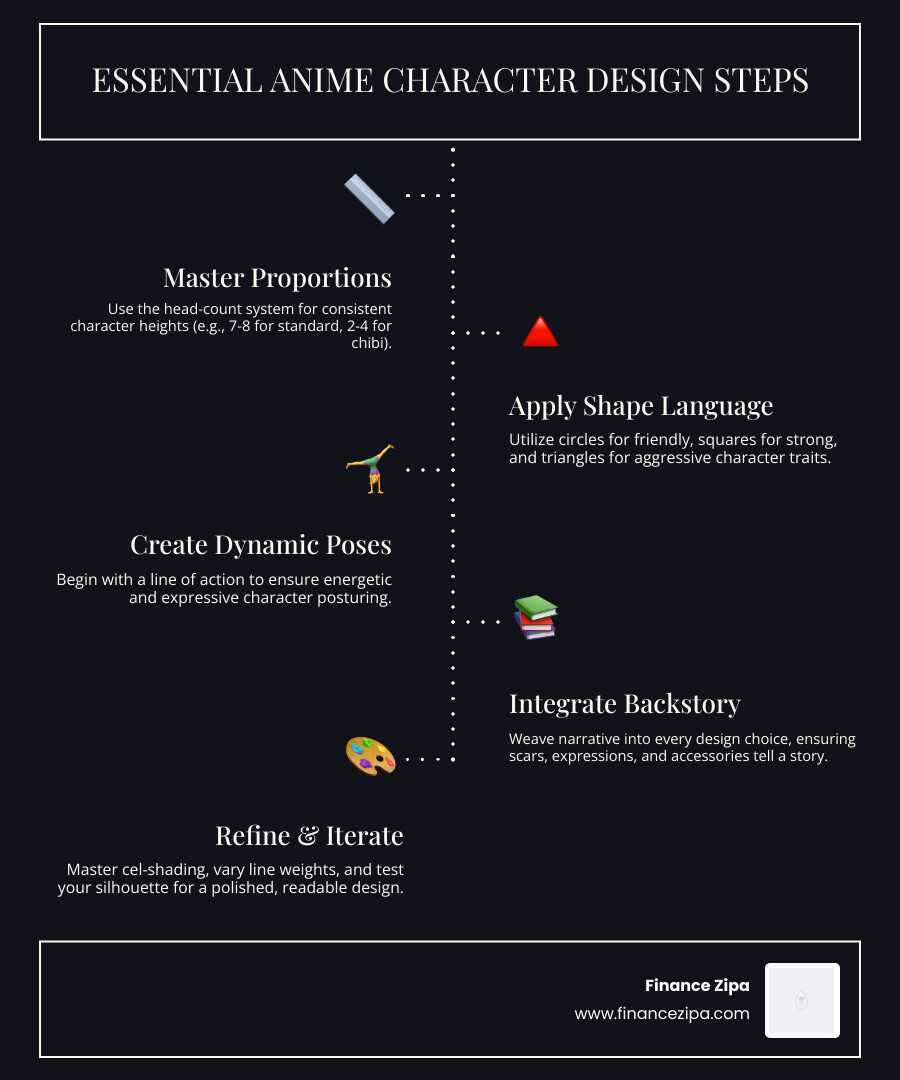
Here’s a quick overview of the core principles:
- Use the head-count system – Standard anime characters are 7–7.5 heads tall. Heroic characters reach 8+. Chibi characters are just 2–4 heads tall.
- Apply shape language – Circles suggest friendliness, squares signal strength, and triangles communicate danger or aggression.
- Start with a line of action – Draw the energy curve first, then build the skeleton around it for dynamic poses.
- Build from backstory – Every scar, expression, and accessory should connect to who your character is.
- Master cel-shading basics – Use hard-edged shadow shapes and varied line weights (thicker on outer contours, thinner on interior details).
- Test your silhouette – If your character isn’t readable as a solid black shape, the design needs work.
- Iterate constantly – Thumbnail multiple versions before committing to a final design.
Many artists make the same early mistake: they study realistic anatomy, then try to “anime-ify” it — and end up with stiff, awkward results that feel neither realistic nor stylized. The truth is that anime anatomy is its own system, with its own rules, proportions, and shortcuts built for readability, emotional expression, and production efficiency.
This guide breaks down every step — from proportions and poses to color theory and common mistakes — so you can design characters that actually look the part.
Mastering Proportions and the Head-Count System
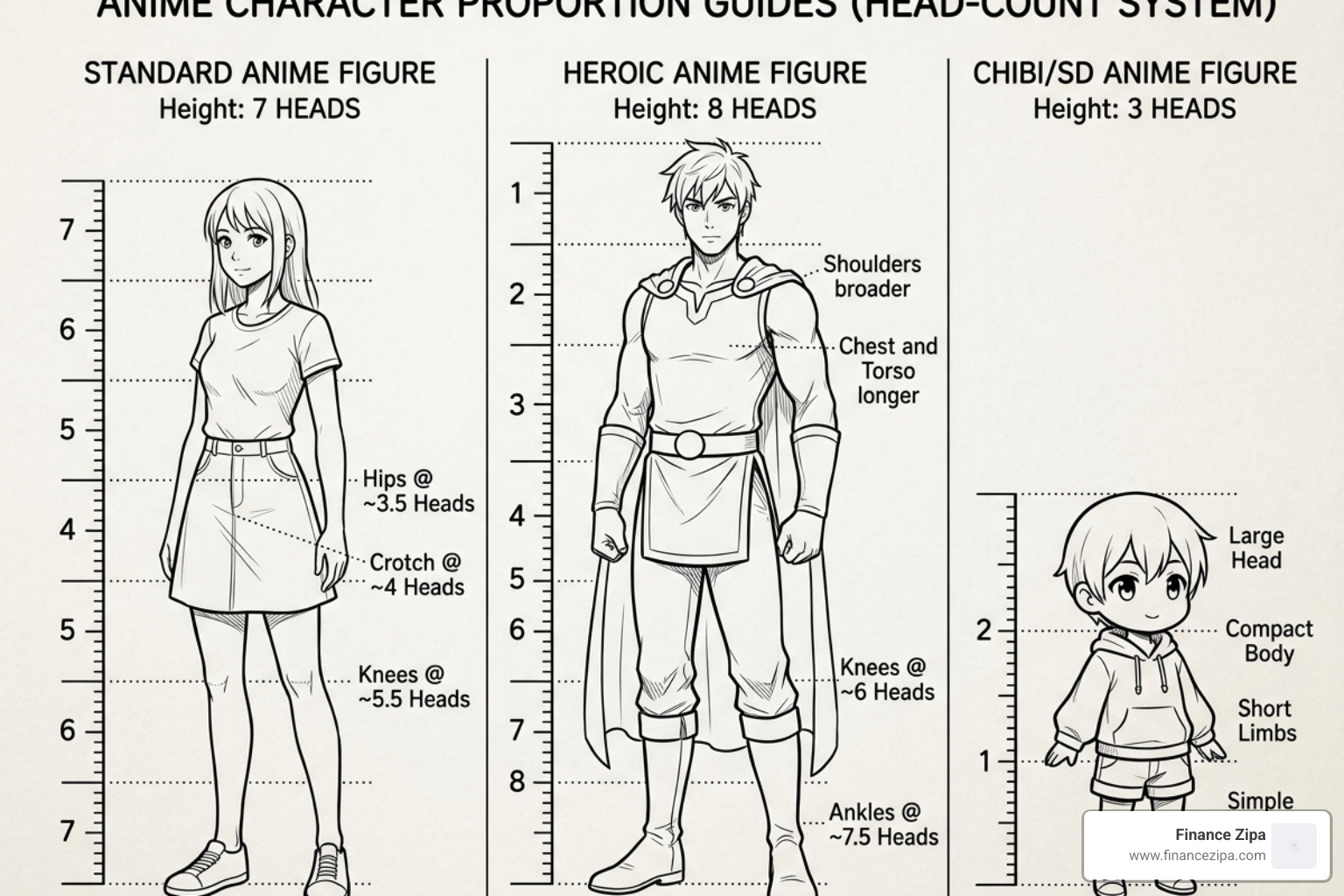
One of the most valuable anime character design tips we can offer at Finance Zipa is to stop guessing how long legs should be. In anime, everything is measured by the “head-count system.” By using the character’s own head as a ruler, we can maintain consistency across different angles and poses.
The Standard Ratios
While a realistic human is typically 7.5 to 8 heads tall, anime often pushes these boundaries for aesthetic appeal:
- Standard Anime (7–7.5 heads): This is your typical protagonist or high school student. It feels grounded but slightly more “elegant” than real life.
- Heroic/Idealized (8+ heads): Common in seinen or action-heavy series. Longer legs and smaller heads make characters look powerful and imposing.
- Children (4–6 heads): Larger heads relative to the body emphasize youth and vulnerability.
- Chibi/Super-Deformed (2–4 heads): Used for comedy or “cute” merchandise.
The Structural Framework
Before we add muscles or clothes, we build a “mannequin.” We recommend starting with a ribcage barrel and a pelvis box. Connect them with a subtle curve for the spine. For joints, use simple circles. A common rule of thumb in anime is that the elbows should align with the waist, and the wrists should reach the crotch level when the arms are resting.
Male vs. Female Silhouettes
Understanding the subtle differences in skeletal structure is key to a professional look:
| Feature | Male Anime Proportions | Female Anime Proportions |
|---|---|---|
| Shoulder Width | Broad (2 to 2.5 heads wide) | Narrow (approx. 1.5 heads wide) |
| Torso Shape | Inverted triangle or “V” shape | Hourglass or “X” shape |
| Pelvis/Hips | Narrow and boxy | Wider and more rounded |
| Waistline | Lower and less defined | Higher and more tapered |
Essential Anime Character Design Tips for Visual Storytelling
Great design isn’t just about drawing a pretty face; it’s about communicating who the character is without them saying a word. This is where shape language and narrative integration come into play.
Professional artists often use 39 Ultimate Character Design Tips for Beginner to Advanced Artists to refine their process, but the core lies in the psychology of shapes.
Using Shape Language as Anime Character Design Tips
Every character can be broken down into three primary shapes:
- Circles: These suggest softness, friendliness, and approachability. Think of protagonists like Kirby or many “moe” characters.
- Squares: These represent stability, strength, and stubbornness. You’ll see these in the “tank” characters or reliable mentors.
- Triangles: Pointy edges suggest speed, danger, or aggression. Most villains have sharp chins, triangular eyes, and spiky hair.
Narrative-Driven Anime Character Design Tips
Your character’s appearance should be a map of their history. If a character has a scar, it shouldn’t just be “cool”—it should remind the audience of a specific fight or hardship. According to community advice on unique character traits, creating a character history first helps you visualize traits that feel purposeful rather than random.
Ask yourself:
- What is their social status? (Influences fabric quality and accessories).
- What is the climate like? (Influences layering and clothing type).
- What is their primary emotion? (Influences their default posture and eye shape).
Constructing Dynamic Poses and Expressive Features
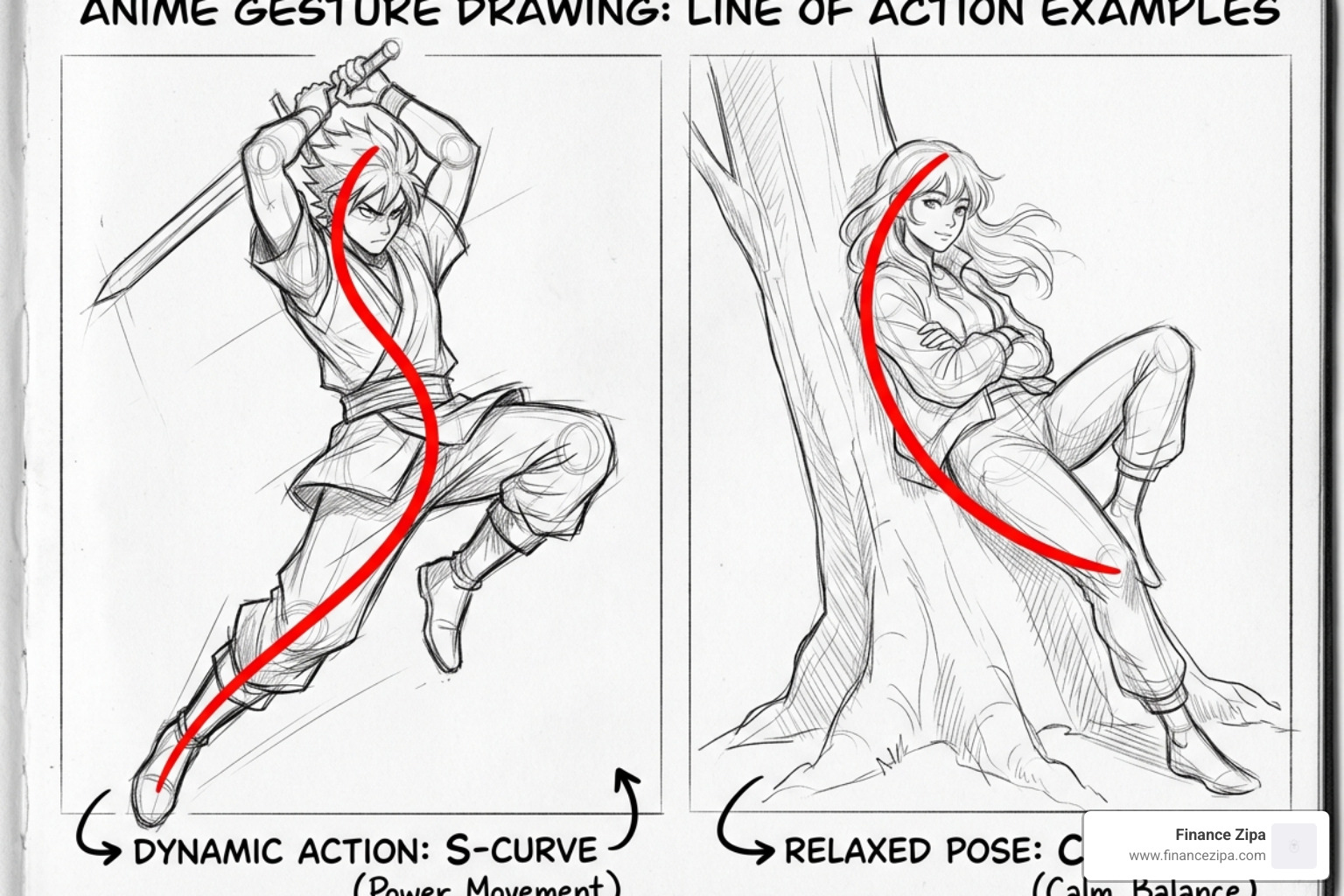
If your character looks like they are “waiting for a bus in the rain,” they lack a Line of Action. This is an imaginary line that dictates the flow of energy through the body.
Gesture and Flow
Before drawing the skeleton, draw a single, sweeping curve. This is your gesture. Whether it’s a “C” curve for a relaxed pose or an “S” curve for an action shot, this line prevents stiffness. We also recommend the silhouette test: fill your character in with solid black. If you can still tell what they are doing and who they are, your pose is successful.
Expressive Facial Features and Anime Character Design Tips
In anime, the eyes carry about 70% of the emotional “read.” To place them accurately, use the “one-eye-width” rule: the distance between the two eyes should be roughly the width of a single eye.
For more advanced construction, A Guide to Creating Anime-Style Characters suggests using facial landmarks. Place the eyes on the horizontal centerline of the head, with the nose halfway between the eyes and the chin.
- Eyes: Large, round eyes suggest innocence; narrow, slanted eyes suggest maturity or suspicion.
- Hair: Don’t draw individual strands. Instead, think of hair as “masses” or clumps. Start with the skull shape, then drape the hair over it, letting gravity and movement dictate the flow.
Professional Workflow: From Line Weight to Color Theory
By the time we reach 2026, the gap between amateur and professional digital art has narrowed thanks to better tools, but the fundamentals of workflow remain the same.
The 60-30-10 Color Rule
To avoid a cluttered look, follow this ratio for your color palette:
- 60% Dominant Color: Usually the base of the outfit.
- 30% Secondary Color: Accents like capes, boots, or hair.
- 10% Accent Color: A bright, contrasting color for eyes, jewelry, or small details.
Linework and Shading
Professional anime art uses varied line weight. Use thicker lines for the outer silhouette and where two forms overlap (like where the arm meets the torso). Use thinner lines for interior details like clothing folds or facial features.
For shading, stick to cel-shading. This means using hard-edged shadow shapes rather than soft gradients. It mimics the traditional animation style and keeps the character looking clean and “pop-y.”
Digital Tools and Efficiency
If you’re using software like Clip Studio Paint, utilize vector layers for your linework. This allows you to “pinch” and adjust lines after you’ve drawn them without losing quality. If you are planning to animate, remember to separate still parts (like the torso) from moving parts (like flowing hair) into different folders.
Avoiding Common Mistakes in Anime Character Design
Even the best artists fall into traps. Here are the most common “red flags” in anime character design tips and how to fix them:
- Stiffness: This happens when shoulders and hips are perfectly horizontal. The Fix: Use contrapposto. Tilt the shoulders one way and the hips the opposite way to create a more natural, dynamic stance.
- “Era Soup”: This is when you mix design elements from different decades (e.g., 90s “big hair” with 2020s “photographic lighting”) without a clear intention. The Fix: Pick a specific “style lane” and stick to it.
- Floating Features (Sticker Eyes): When eyes don’t follow the 3D curve of the face. The Fix: Draw wrapping guidelines around the head to ensure features sit on the same plane.
- Hairy Lines: Drawing with short, “pecking” strokes. The Fix: Use your shoulder, not just your wrist, and practice “ghosting” the stroke before committing to one long, confident line.
- The “Lollipop” Neck: Attaching a thin, straight neck to the tip of the jaw. The Fix: Remember the neck is a cylinder that anchors under the skull, behind the jaw.
Frequently Asked Questions about Anime Character Design
How do I start drawing an anime body for beginners?
Start by mastering the head-count system and the basic skeleton. Don’t worry about clothes or hair yet. Draw 10 “mannequins” using the 7-head system to get used to the landmarks (like the waist at the 3rd head mark). Once you can draw a balanced skeleton, adding “volume” with cylinders becomes much easier.
What are the key differences between male and female anime proportions?
It mostly comes down to the “shoulder-to-hip” ratio. Males have broad shoulders and narrow hips (the “V” shape), while females have narrower shoulders and wider, more rounded hips (the “X” or hourglass shape). Additionally, male faces often have more angular jaws, while female faces are softer and more rounded.
How can I make my anime character designs look more professional?
Focus on three things: silhouette readability, line weight variation, and consistent shading. A professional design is one that can be recognized just by its shadow. Use thicker lines for the outer contours and keep your shadow shapes simple and graphic. Avoid over-detailing; in anime, less is often more.
Conclusion
Designing an iconic anime character is a journey of a thousand sketches. It requires a blend of technical anatomy, psychological shape language, and narrative depth. Talent is simply a “practiced habit”—no one starts out drawing masterpieces. By applying these anime character design tips, you are building the mental scaffolding needed to create characters that resonate with audiences.
At Finance Zipa, we believe that everyone has a unique story to tell through their art. Whether you are building a portfolio for a studio or just creating for yourself, focus on the “why” behind your design choices. Keep a reference library of your favorite artists, practice your daily micro-drills, and don’t be afraid to make a mess on the canvas.
Start your creative journey with our expert resources and unlock the tools you need to bring your digital world to life.
